
Impressions of China
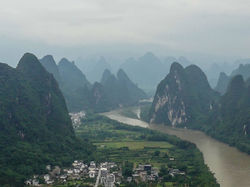
The advantage of visiting China on this website is that you can do so without having your passport scanned a number of times a day, at every significant move you make. The 'downside' is that here on the site you are deprived of the opportunity to smile at the multitude of cameras in streets, parks, buses and trains. In all, though, I sincerely hope that these pages are an incitement to visit the place in flesh and blood, because China is pure magic for its nature, culture and history, the people are really welcoming and the food is absolutely great.China, the 'Empire of the Middle' going back 5,000 years in history, with successive dynasties, alternating feudal break-ups and centralised empires. To guide you through the country's imperial timeline, we also present here a short, very simplified description of dynasties, just click on the button. China is also a country of modern times, the awakened giant of 1.3 billion people, having overcome the humiliation of 19th century British and French 'concessions' embedded in the 'Unequal Treaties', Japanese invasions and the internal brutality and communist fanaticism of the Cultural Revolution of the 1960s. The traces of it all are still there, in the imperial capital cities of Beijing and Xi'an, and in the 'smaller' towns such as Pingyao alike: Buddhist, Taoist and Confucianist temples; ancient city centres with mighty walls encompassing narrow alleys of wooden houses; imperial palaces as large and sumptuous as their emperors were powerful, autocratically ruling over their territories and inhabitants; Shanghai's 19th century colonial buildings on the Bund and the modern design skyscrapers lining the Huangpo riverbanks; Tibetan temples and caves devoted to Buddhism; Uyghur historical presence in the northwest region of Xinjiang connecting China to Central Asian civilisation. But China is not a country like any other, it has the allure of a continent. And continents have a variety of ethnicities, languages, cultures and natural richess. So does China. In the west, the Xinjiang autonomous region there are the Islamic Uyghur with Turkic roots, in the south Tibet is devotedly Buddhist, multitudes of temples and sanctuaries adding to the fascination of the Himalayan mountains, of which the Everest literally tops it all with its 8,849 metres, and in the centre and east there are the historical, classical China and the magnificent karst mountains, spectacular stand-alone sculptures crafted by the tectonic forces and natural elements of wind and water; there are the rolling landscapes of lush subtropical vegetation, dotted with traditional, authentic villages and covered with centuries-old tea plantations and terraces of rice culture around Guilin; there are the long and winding rivers flowing in strong currents towards the South China Sea, meandering through flat plains and mountains around Yangshuo; there are the dustbowls of the Tatlamakan and Gobi deserts, at times flogged by violent sandstorms and scorched by the relentless sun.China, a continent. After thousands of kilometres in Chinese fast trains, planes and cars, one realises still better how much travel there remains to be done before one can even begin pretending to have on offer more or less comprehensive 'impressions of China'. Yes, Yunnan, Sechuan and so on are on the 'still to visit' list, but even after those, there will still be no shortage of worthy destinations in this fascinating continent-country with its surprisingly welcoming people, adults and children alike, who heartwarmingly crave contact...
Dynasties in a simple timeline
Pingyao, Xi'an, Zhangzaijie, Guilin, Yangshuo
Lhasa, Gyantsé, Shigatsé, Sakya, Everest
 |
|---|
 |
 |
 |
 |
 |
 |
 |
 |
Kashgar, Hotan, Kuqa, Korla, Turpan, Ürümqi
© 2020.Created by Marc Van den Reeck with Wix.com